Repair or Replace? How to Decide on a Water Heater
Some water heater problems are a small part and an hour of work. Others mean the tank has reached the end, and the signs are fairly clear.
October 8, 2026 · 4 min read
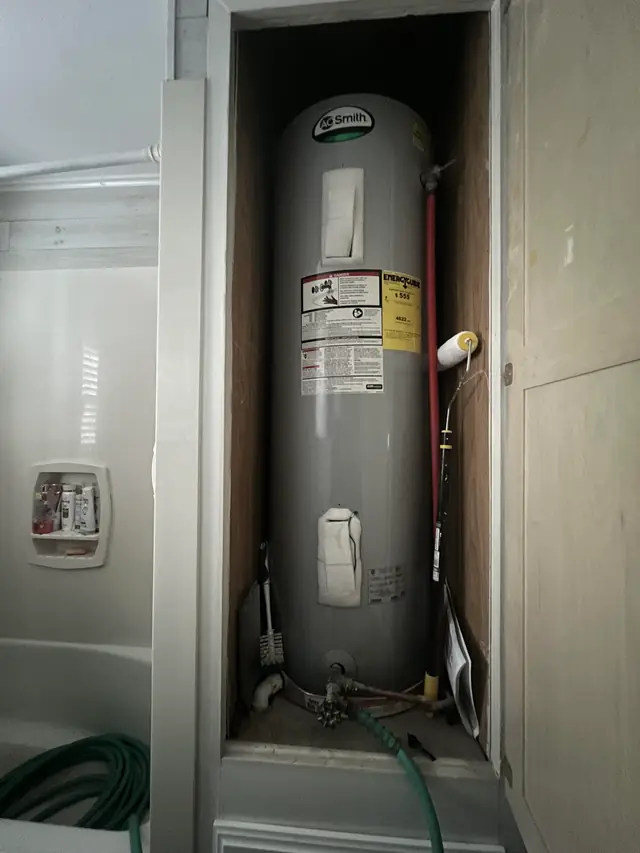
A cold shower is a bad way to start a decision about a few thousand dollars. Before the heater fails, or right after, it helps to know what points toward a repair and what points toward a new unit. You do not need to be an expert. You need to know the right questions and what the answers usually mean.
Start with age and where the problem is
Look for the date on the label on the side of the tank. Tank-style heaters commonly last somewhere around eight to twelve years, depending on the water, the model and how well it was looked after. A unit well past ten years that is acting up is a weaker candidate for repair than a six-year-old unit with the same symptom, since the next failure is probably close behind.
Then work out where the trouble is. Problems that come from a replaceable part, like a heating element, a thermostat, a gas control valve or a pilot assembly, are usually repairable. Problems that come from the tank itself are not.
Leaks: the line between repair and replace
A heater can leak in a few places, and they mean different things. Water at a fitting on top, the inlet or outlet connections, or the temperature and pressure relief valve can often be fixed without replacing the tank. But water pooling under the unit that is coming through the tank wall means the steel liner has corroded through. That is not patchable, and the tank will only get worse. If you see a steady puddle, shut off the water supply and the power or gas, and call.
Rust-colored hot water, while cold water is clear, is a related warning. Sometimes it is just old pipes, but with an aging tank it often means the inside is corroding.
Noise, recovery and everything else
Rumbling, popping or banging usually means sediment has built up at the bottom of the tank and water is boiling beneath it. A flush can help, though a heavily scaled old tank may already be losing efficiency for good. Running out of hot water faster than you used to is another clue. On an electric unit, that can be a failed heating element, which is a modest repair. On a tank with a thick bed of sediment, it can be the tank itself, and no part fixes that.
A useful rule of thumb: one inexpensive repair on a middle-aged heater is reasonable. A second repair within a year on an old one usually means you are paying to delay the replacement.
Electric and gas: what changes
Electric heaters are simpler. They heat water with two elements and thermostats, and most repairs involve one of those parts. Gas units add a burner, a pilot or ignitor, a thermocouple and a gas control valve, plus venting that has to be right. That is one more reason to leave gas work to a licensed plumber: a small mistake with combustion or venting is a safety issue, not a nuisance. Either way, when a replacement is needed, the installer should be able to explain what is being swapped, what is staying, and what they will test before leaving.
Why a fair quote matters
This is where homeowners get squeezed, because no one wants to haggle with the water off. Kelly Fromm wrote in her Google review that she had been quoted $3,100 to replace an electric water heater. She asked around online and got a strong response that the number was too high. Two other licensed companies told her their quotes would line up with that figure, and one of them proposed an $89 fee just for providing the quote. She ended up choosing Artesian, and the replacement cost $1,750.
The price is not the only part worth noticing. She said the crew explained the process clearly before starting, finished quickly, and "stayed for 10-15 minutes after to make sure no issues." She also made a point worth repeating: she only hires licensed contractors, because she notes that using an unlicensed one can lead to a homeowner's insurance claim being denied if something goes wrong with their work. That is her experience and her reasoning, but it is a fair question to ask any plumber before the work starts.
So get the quote in writing or at least itemized: the unit, the labor, the haul-away of the old one, and anything else. Ask what happens if the job turns up a problem. A clear answer is a good sign.
Making the call
If your heater is old, leaking from the tank or needing a second repair, replacement is probably the better value. If it is younger and the problem is a single part, repair makes sense. When you are not sure, Artesian can talk it through at (903) 849-2393, Monday through Friday, 9:00 AM to 4:30 PM. Tell them the age, the fuel type and what you are seeing.
Artesian Plumbing, LLC, (903) 849-2393
Call (903) 849-2393More articles
Why Choose Artesian Plumbing for Your Business Needs?
A restaurant, a shop and an office all ask different things of their pipes, and a good plumber starts by finding out which one you are.
Common Plumbing Problems and How to Fix Them
Most household plumbing problems start small, and knowing which ones are yours to handle saves a lot of money and a few wet floors.