What a Tankless Water Heater Flush Actually Does
A tankless heater only heats water when you ask for it, and the minerals in that water slowly crust the parts that do the work.
October 8, 2026 · 3 min read
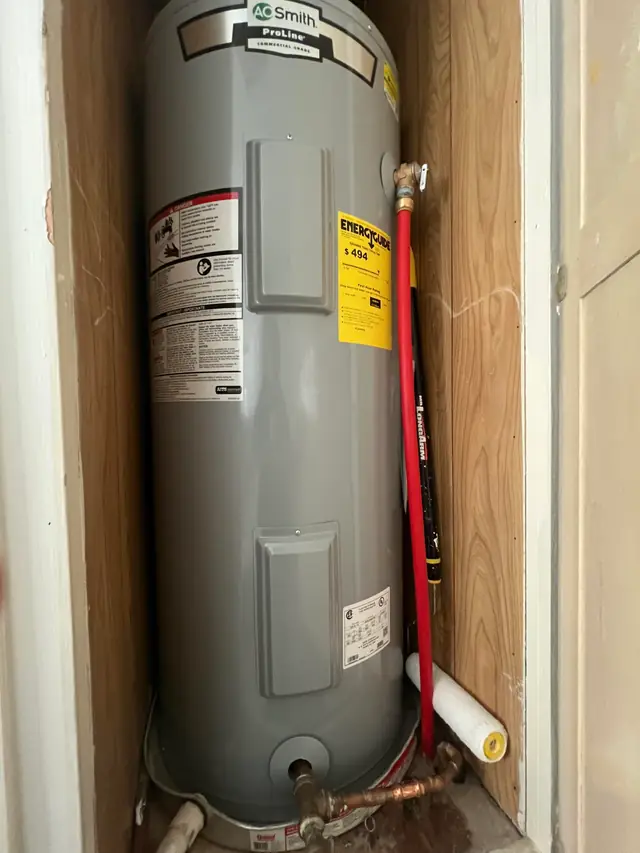
A tankless water heater has no big tank sitting full of hot water. When you open a tap, water runs through a heat exchanger, a set of narrow passages, where a burner or heating element warms it on the way past. That design saves space and delivers hot water for as long as you need it. It also means all of the water your house uses passes through some very small channels, and whatever is dissolved in that water gets left behind there. A flush is how you clear it out.
Why scale builds up
Water carries dissolved minerals, mostly calcium and magnesium. When water gets hot, those minerals come out of solution and stick to the nearest surface as scale. In a tank heater, a lot of it falls to the bottom as sediment. In a tankless unit, it coats the inside of the heat exchanger. The passages are narrow to begin with, so a thin layer does real damage: it restricts flow and works as insulation, so the unit has to work harder to move the heat into the water. The harder your water, the faster this happens.
Signs your unit is asking for attention
Scale does not announce itself on day one, but there are patterns worth noticing:
- Hot water temperature that swings up and down in the shower, with no change on your end.
- Reduced flow at taps, especially hot only, while cold runs normally.
- An error code on the display. The code list is in your manual, and several of them point to flow or overheating problems.
- Longer waits for hot water, or a unit that seems louder than it used to be.
- A higher gas or electric bill with no change in how you use hot water.
None of these prove scale is the cause, and a good plumber will check before assuming. But a flush is a modest job compared with replacing a heat exchanger, so it is often the first thing to rule out.
What a flush involves
The idea is to run a cleaning solution through the unit and then rinse it clear. Here is how that typically goes.
First the unit is shut down: power or gas off, and the water supply closed. Most tankless heaters have isolation valves on the hot and cold lines, which let you connect hoses without draining the whole house. If yours was installed without them, mention that on the phone, because it changes the job.
Next, hoses connect to those service ports, with one end running to a small pump and a bucket. A descaling solution goes into the bucket. Many manufacturers approve white vinegar or a purpose-made descaler. The pump circulates the solution through the heat exchanger and back into the bucket, commonly for around forty-five minutes to an hour. You can often tell it is working because the liquid changes color as it picks up mineral deposits.
Then the system is flushed with clean water, so no cleaning solution is left in the lines. The inlet filter, a small screen on the cold water side where the water enters the unit, gets pulled out and cleaned of grit, since a clogged screen mimics the same low-flow symptoms. Finally, the valves go back to normal, power or gas is restored, and the unit is run to confirm that it heats evenly and no error codes appear.
How often to consider it
Many manufacturers recommend roughly once a year, more often with hard water, so check your unit's manual for its own guidance. That interval is a reasonable starting point. If you notice any of the symptoms above sooner, do not wait for the anniversary. Skipping flushes for years is the usual reason a unit eventually needs a bigger repair, and some warranties ask for proof of maintenance, so keep the paperwork.
What it costs at Artesian
Artesian Plumbing lists its Tankless Water Heater Flush Service at $225 and sets aside about 2 hours for it. That is a published price, not an estimate, though a unit with unusual problems or no isolation valves may mean a different conversation. Compared with the cost of replacing a heat exchanger or an entire unit, it is a small line item that protects a large one.
If your tankless heater has been running hot and cold, throwing error codes or just feels like it is losing ground, give Artesian a call at (903) 849-2393. Tell them the brand and model, if you can read it off the unit, and what you have noticed. That detail helps them plan the visit.
Artesian Plumbing, LLC, (903) 849-2393
Call (903) 849-2393More articles
Why Choose Artesian Plumbing for Your Business Needs?
A restaurant, a shop and an office all ask different things of their pipes, and a good plumber starts by finding out which one you are.
Common Plumbing Problems and How to Fix Them
Most household plumbing problems start small, and knowing which ones are yours to handle saves a lot of money and a few wet floors.